Regulations: batteries and accumulators
Guidance for manufacturers on placing batteries and accumulators on the market.
Overview
In the United Kingdom the Batteries and Accumulators (Placing on the Market) Regulations 2008 are the underpinning legislation:
- making it compulsory to collect and recycle batteries and accumulators
- preventing batteries and accumulators from being incinerated or dumped in landfills
- restricting the substances used in batteries and accumulators
What is covered
The regulations cover all types of batteries, regardless of their shape, volume, weight, material composition or use; and all appliances into which a battery is or may be incorporated.
There are some exemptions including batteries used in:
- equipment connected with the protection of the essential security interests of the UK, such as arms, munitions and war material, and intended for specifically military purposes
- equipment designed to be sent into space
Extent of obligation
If you design or manufacture any type of battery or accumulator for the UK market, including batteries that are incorporated in appliances, they:
- cannot contain more than the agreed levels of prohibited materials
- must be labelled correctly
- and be readily removable.
Find out what types of batteries are regulated.
How to comply
Mercury
Batteries cannot contain more than 0.0005% of mercury by weight. However, button cells can contain up to 2% mercury by weight if marked with the chemical symbol Hg and placed on the market before 1 October 2015.
Cadmium
Batteries cannot contain more than 0.002% of cadmium by weight unless marked with the chemical symbol Cd and falling into the following categories:
- portable batteries intended solely for alarm systems, emergency lighting and medical equipment
- cordless power-tools placed on the market before 1 January 2017
- industrial batteries
- automotive batteries
Lead
Batteries cannot contain more than 0.004% of lead by weight unless marked with the chemical symbol Pb.
Labelling batteries correctly
All chemical labelling on batteries must be visible, legible and indelible. Batteries must also be labelled with a crossed out wheeled bin symbol as shown below.
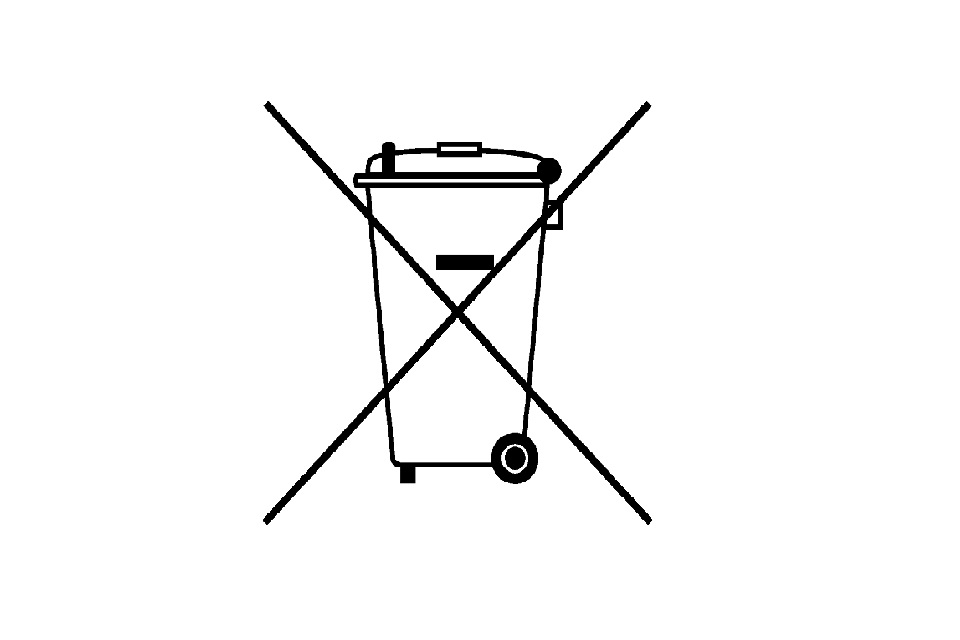
The crossed out wheeled bin symbol must cover:
- at least 3% of the surface area of the largest side of a non-cylindrical battery or battery pack, or
- at least 1.5% of the total surface area of a cylindrical battery, and, in either case, up to a maximum size of 5 cm x 5 cm
If a battery is so small that the size of the symbol would be less than 0.5 x 0.5 cm, then you must place the symbol on the packaging, but it must be at least 1 cm x 1 cm.
Where a battery is provided within another piece of equipment and it is impractical to mark the battery, the symbol must be marked on the packaging of the product.
Chemical symbols
Any chemical symbols required must:
- be directly below the crossed out wheeled bin symbol and
- cover an area of at least 25% of the crossed out wheeled bin symbol
Capacity labelling
You must label:
- portable rechargeable batteries with their capacity in milliampere-hours (mAh) with a whole number or ampere-hours (Ah) with only one digit after the decimal point
- automotive batteries with their capacity both in ampere-hours (Ah) and in cold cranking amperes (A), written as whole numbers
You must make sure that the minimum size and location of capacity markings on batteries is as shown in the following table:
| Type of battery | Location of marking | Minimum size of label on battery or battery pack (height x length) | Minimum size of label on packaging (height x length) |
|---|---|---|---|
| Portable rechargeable (except button cells and memory back up batteries) | On the front of the packaging and on the individual batteries. If sold without packaging, on the battery or accumulator | 1.0 x 5.0 mm | 5.0 x 12.0 mm |
| Rechargeable battery packs where the largest side is equal to or above 70 cm squared | On the external housing of the cell’s assembly (individual cells inside the housing do not require marking) | 2.0 x 5.0 mm | Not applicable |
| Rechargeable battery packs where the largest side is below 70 cm squared | On the external housing of the cell’s assembly, individual cells inside the housing do not require marking | 1.0 x 5.0 mm | Not applicable |
| Button cells and memory back-up batteries | On the front of packaging | not applicable | 5.0 x 12.0 mm |
| Automotive batteries and accumulators | On the largest side of the battery but not on the bottom side | Covering at least 3% of the area up to a maximum of 20 × 150 mm | Not applicable |
If the size of the battery, accumulator or battery pack is too small to be suitably marked, the capacity must be marked on the packaging with a minimum size of 5.0 × 12.0 mm (height x length). If it is not supplied with its own packaging, the capacity must be marked on the packaging of the appliance it is sold with.
Making batteries readily removable
Appliances that incorporate batteries must be designed so that the end user can readily remove the battery safely, without difficulty and when necessary using the instructions provided. Where it is not possible for the end user to remove the battery, an independent qualified professional must be able to readily remove it. The instructions must explain the type of battery incorporated, where appropriate. This does not apply where a permanent connection between the appliance and the battery is needed for safety, performance, medical or data integrity.
The role of the Office for Product Safety and Standards (OPSS)
The Office for Product Safety and Standards has been appointed by Defra to enforce the regulations in the United Kingdom.
Where to find out more
Batteries and Accumulators (Placing on the Market) Regulations 2008
Batteries and Accumulators (Placing on the Market) (Amendment) Regulations 2012
Waste Batteries and Accumulators (Amendment) Regulations 2015
Contact us
If you have a specific enquiry about compliance or wish to contact us regarding suspected non-compliance please email OPSS.enquiries@businessandtrade.gov.uk.
Alternatively you can contact our helpdesk on 0121 345 1201.
Or in writing to:
Office for Product Safety and Standards
4th Floor Cannon House
18 The Priory Queensway
Birmingham
B4 6BS
United Kingdom
Last updated 1 January 2021 + show all updates
-
Updated at the end of the transition period to reflect minor amendments to the regulations, which do not impact on how to comply.
-
EU Exit Update.
-
Updated guidance on mercury and cadmium restrictions and making batteries readily removable.
-
First published.